
Houdini & Procedural Workflows / Houdini
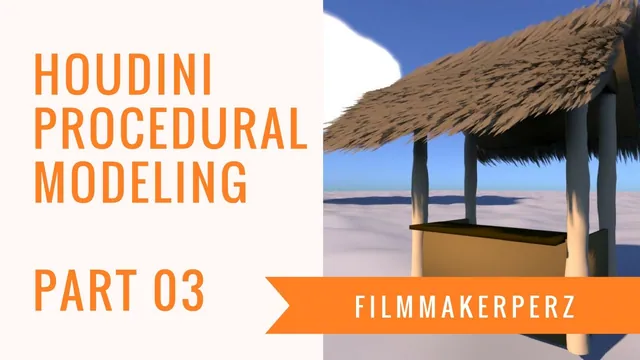
Tiki Hut Tutorial | 3D Procedural Modeling in Houdini - Part 03
Written guide
Playing loads YouTube content. YouTube processes data after activation.
Watch on YouTubeIf the player is blocked or unavailable, use Watch on YouTube.
Give the tiki hut’s posts an irregular log-like surface, add upper side supports and prepare a clean roof output for the next lesson’s thatch. Part 3 continues the existing procedural frame and roof; the exact Houdini version is unverified.
The modeling is intentionally guided by the intended camera. The instructor does not build every hidden support or resolve every protrusion, because later roof grass will cover some areas. This is a shot-oriented modeling pass, not a structural construction specification.
Vary the posts without increasing the deformation everywhere
At 00:00, insert Mountain into a column branch. Its default effect is much too strong, so reduce the intensity until the column reads as a slightly irregular log rather than a heavily distorted form.
At 01:04, copy the noise setup to the other posts. Initially, the copies share the same pattern. Change their noise offsets independently so each post samples a different part of the noise.
At 02:07, the instructor emphasizes that this changes the pattern rather than making the deformation stronger. Keep those controls conceptually separate: intensity determines how far the surface is displaced, while the offset changes the sampled variation. Inspect the silhouette and the junctions with the rest of the hut after each adjustment.
The source does not automate unique seeds for an arbitrary number of columns. It manually varies the existing branches and accepts the resulting differences.
Derive the upper side supports from existing boxes
At 03:02, identify a side box already positioned appropriately and copy it as the starting point for an upper support. Merge the new branch into the complete hut.
At 04:05, remove the old height/placement channel relationship that no longer suits the copied part, restore its starting value and reference the column height for the new upper position. The captions do not preserve the complete expression path, so inspect the referenced channel in the existing scene instead of guessing it from a node label.
At 05:01, reduce the support’s height scale to about 0.25 and offset it outward using the column radius. Referencing that radius gives the placement a relationship to the actual post thickness instead of relying only on a manually chosen distance.
The instructor accepts a protruding portion because the later grass covering is expected to hide it. Keep that decision visible when evaluating another camera angle; concealed geometry in one shot may become exposed in another.
Reflect the complete placement relationship to the other side
At 06:05, copy the new support branch for the opposite side. Wrap the entire X-position expression in parentheses and multiply it by −1.
The parentheses matter because the reference and its offset should change sign together. Negating only the last term can leave the copied support in the wrong place even though the expression remains syntactically valid.
Inspect both supports after the change. Their opposing positions should still correspond to the same column dimensions. The recording demonstrates this one arrangement, not a comprehensive test of every possible hut size.
Expose only the roof panels for the next operation
At 07:04, merge the two roof-panel branches into a dedicated output and append a Null named OUT_ROOF. This creates an easy-to-find reference in a network that now contains many construction nodes.
The output has a specific purpose: the next lesson can import the roof surfaces without selecting the entire hut. Check that it contains both intended panels and excludes the posts, counter and side supports.
The following roof-grooming lesson uses this handoff to generate the covering. At the end of Part 3, the noise variation, side supports and roof output are established; the grass, finished materials and view-independent cleanup remain later work.