
Making Roll for Disaster: How I Directed the Same AI Film Twice
Follow one castle shot from a reference brief to a finished cut. Compare two original performances, inspect the budget and try the same experiment on your own scene.
Watch the documentary
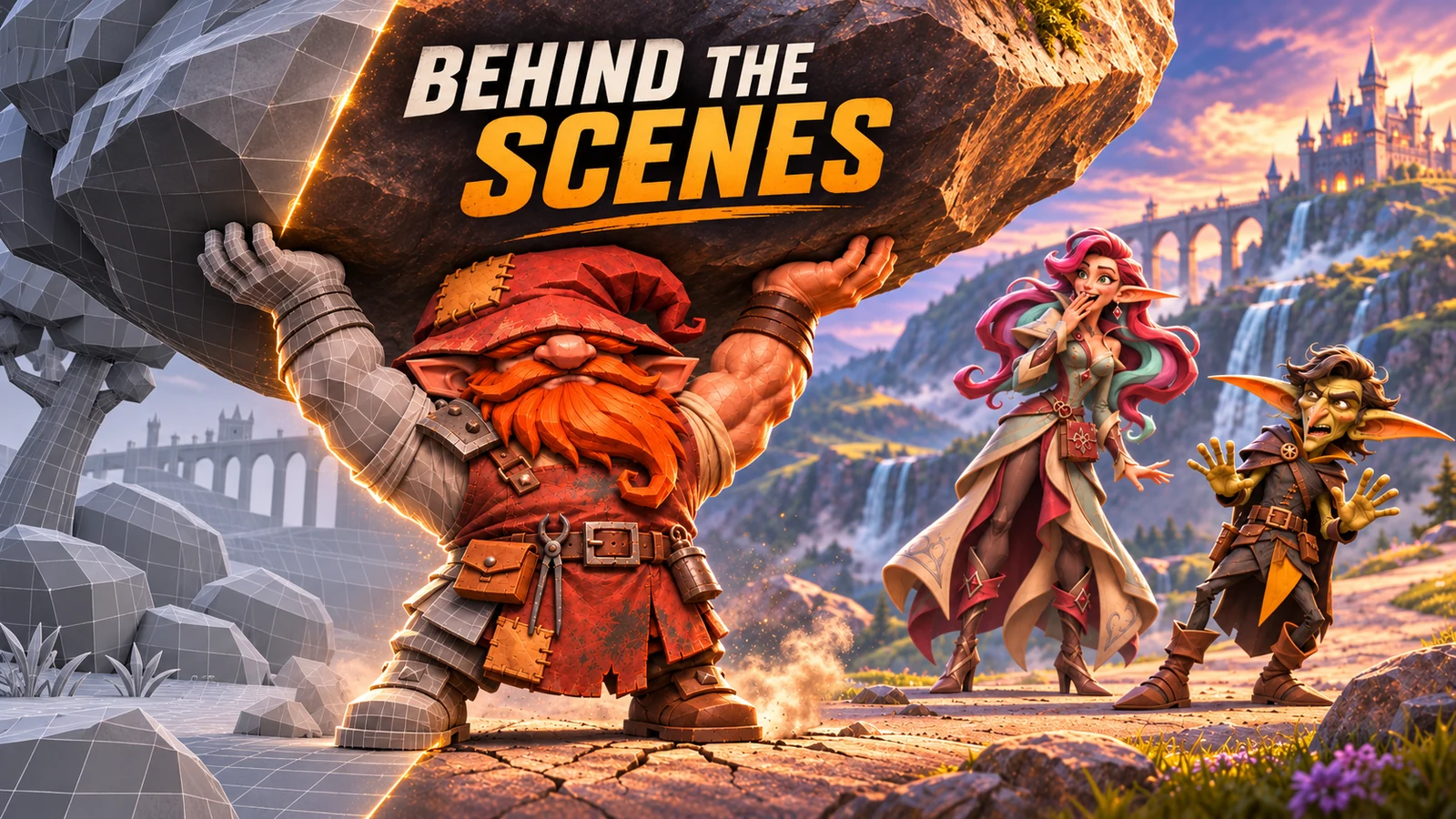
Playing loads YouTube content. YouTube processes data after activation.
Watch on YouTubeIf the player is blocked or unavailable, use Watch on YouTube.
Documentary · English
Read the transcript · English captions (VTT) · Chapters (VTT)
Give the audience a reason to follow the roll
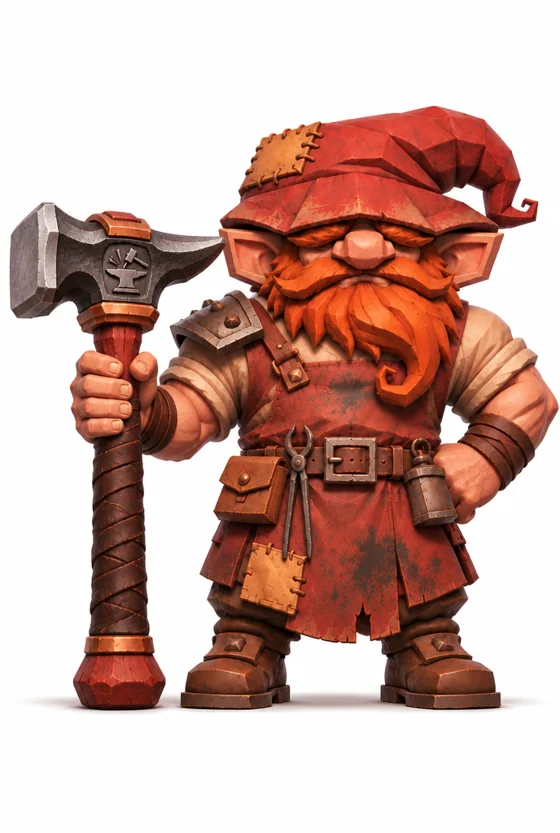
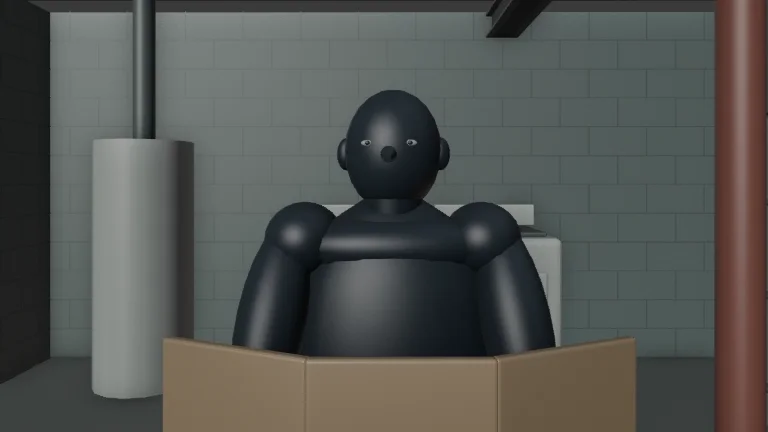
A retired blacksmith wants to move a boulder. In the basement, his player has to persuade a very skeptical Dungeon Master to let him try. The joke works if we understand two things before the roll. The Gnome is only one foot ten, and he really is extremely strong. I wrote the tiny character as a retired smith because it gave us a reason for the hammer, the broad hands and the battered apron. Those details stayed readable even in a wide view.
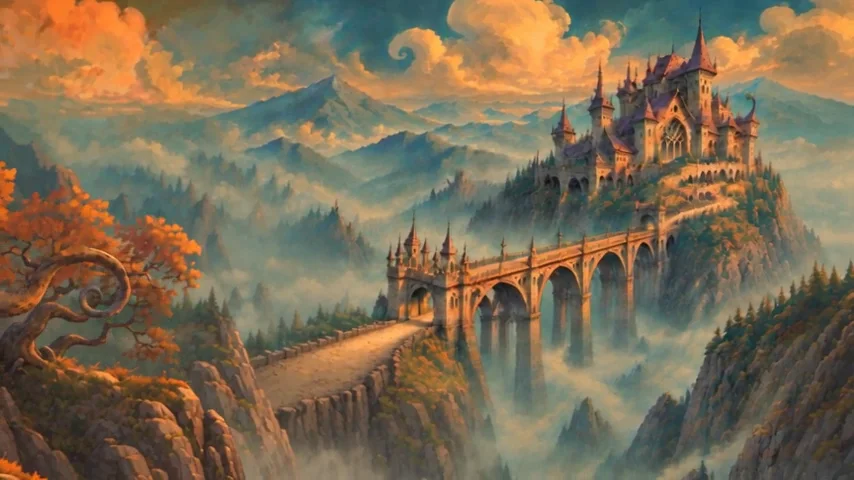
The film moves between a photographic basement and a painterly fantasy pass. At the table, the Dungeon Master can begin a sentence and continue over the castle reveal. On the mountain, the audience needs to see the pass, bridge and destination in the same geography. I developed those handoffs with ChatGPT, then used separate live-action and fantasy scripts. That let me judge the player’s correction as a performance and the Gnome’s lift as a physical action.
Connect the tools and follow one file
I used ChatGPT for story and design discussion. Codex worked with local files and called Higgsfield’s official MCP tools. Seedance 2.5 generated the moving pictures and their native sound. Local Blender scripts built and rendered the movement guides. The Blender MCP connection also let us inspect the scene. DaVinci Resolve and Fairlight handled the cut, dialogue and mix. Each step left something I could inspect before deciding what to do next.
- Connect in a supported host. Higgsfield requires an active subscription and an account in the host. In ChatGPT, find Higgsfield in the Plugins Directory, select Add, sign in and authorize your account. Open the Higgsfield setup guide or read the host-specific connection instructions. Clients requesting a server address use
https://mcp.higgsfield.ai/mcp. Our original setup recording shows ChatGPT’s connector flow. Episode 01’s later requests ran in Codex. - Inspect the current model. Ask which video models and reference types are available and what their input limits are. Test for an authenticated result. A visible connector name alone didn’t tell us whether the connection worked. For mobile access, open Higgsfield’s website in your phone browser. Higgsfield currently lists the browser and official connector as supported surfaces and offers no standalone mobile app. Official platforms.
- Request a quote. Our castle shot, AN01, used nine existing stills with Seedance 2.5 Omni Reference. We requested 14 seconds of horizontal 480p draft with native sound. The historical quote was 42 credits. The caller submitted it under the approved batch budget.
- Match the result to the request. The recorded session shows the invocation, progress, a completed castle preview, then the local retrieval command. Four preview frames match the archived MP4. We inspected the saved file and kept it alongside its private job receipt. Even after the first cut separated this picture from its own sound, I could still find the untouched take.
Give each reference one job
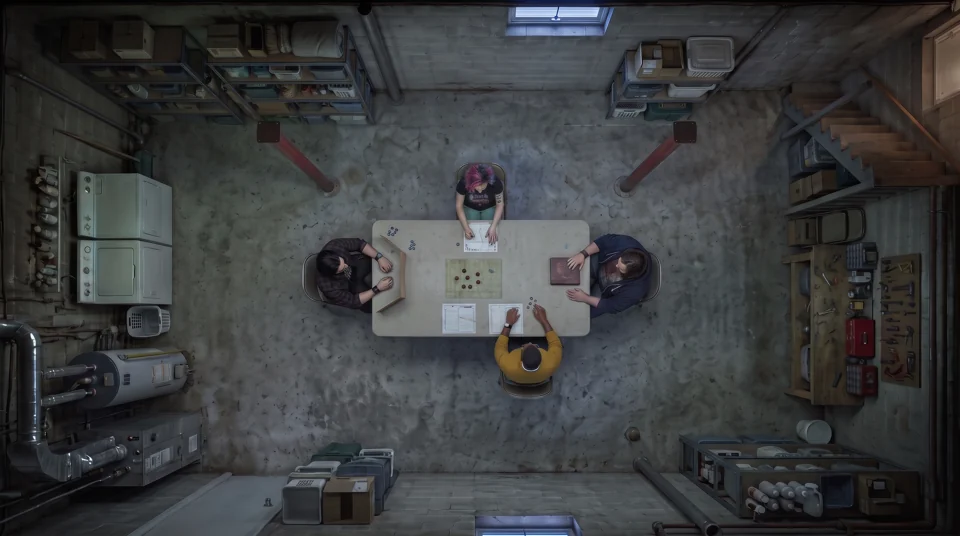
We began with 43 approved images. An individual hero and the wardrobe flat lay settled a character’s appearance. The overhead fixed the seats and the contents of the table. The basement environment supplied architecture and lighting. A different image of the same room included snacks and drinks, which kept turning up in generated shots. Naming an authority for each decision made that error easy to identify. The written heights outranked the illustrated height charts.
| Question | Reference we assigned | What to check on the output |
|---|---|---|
| Who is speaking? | Individual hero, wardrobe and an approved native voice excerpt | Hair, costume, actor identity, timing and any repeated words |
| Where is everyone? | Overhead staging and the appropriate room view | Same chair, eyeline, table dressing and direction of light |
| How large is the obstacle? | Written scale, fantasy environment and blocking art | The Gnome looks tiny beside the rock and the route stays readable |
| What just happened? | A still or short silent excerpt from the preceding successful take | Boulder position, direction of travel, surviving bridge and landing surface |
Keep creative references, generated originals and editorial derivatives in separate folders. Preserve the approved script revision and record which files went into each request. A color-coded contact sheet is convenient, but a text row pairing each filename with its purpose is enough to start.
Spend in stages and carry the state forward
The nine opening takes were quoted at 405 credits. I approved a 500-credit ceiling. Two pickups added 39, bringing the pass to 444. We could advance the basement and castle reveal at the same time. We waited on the Raven’s landing because the available masonry depended on the exact bridge collapse. For the Gnome’s walk we could pass a short silent excerpt forward without importing dialogue from the previous take.
| Recorded production stage | Credits | What it covers |
|---|---|---|
| First draft | 444 | Nine original takes and two pickups |
| Second pass | 249 | Targeted revisions |
| Seven matched scenes in A and B | 869 | 432 per arm and five credits of reference fixes |
| Two title candidates | 60 | Final title generation |
| Attributable subtotal | 1,622 | Excludes unreconciled early art, auditions and initial title development |
These figures describe this production. They do not establish today’s model price or a complete cash budget. Record the current request’s quote, the authorized maximum and its actual debit in separate columns. Update the quote when you change a request. In our A pass the service rejected an extra die video because the supplied reference videos together exceeded 30 seconds. The existing scene guide already carried the roll, so we removed the redundant clip and requoted the job.
A teaching example you can adapt. “Prepare a draft request for the party reaching the obstacle. Use the cast reference for appearance and the pass reference for geography. Hold the bridge and the destination in the same view. Return the reference assignments, duration and current quote for review.” This is a newly written example. Approval to spend comes separately.
Rehearse the pivot and the point of contact
At the gaming table I wanted the camera to turn toward the speaker from one fixed spot. An orbit would carry it around the table and change the relationship between the players. A simple check in Blender was to scrub the turn and look at the camera’s location as well as its rotation. The sampled 28 mm guide kept the optical center in the same position. The guide also showed why a character could disappear behind the Dungeon Master’s screen.
For the fantasy guide I watched the boots, hands and underside of the boulder before worrying about details on the castle. The party approaches from the left, gets underneath the load and travels toward the bridge on the right. If the stone floats before either hand touches it, the guide is teaching the wrong action. We revised a 34-frame earlier composite whose hand release still felt light. A correct pose on one frame didn’t answer how quickly the weight should leave his hands.
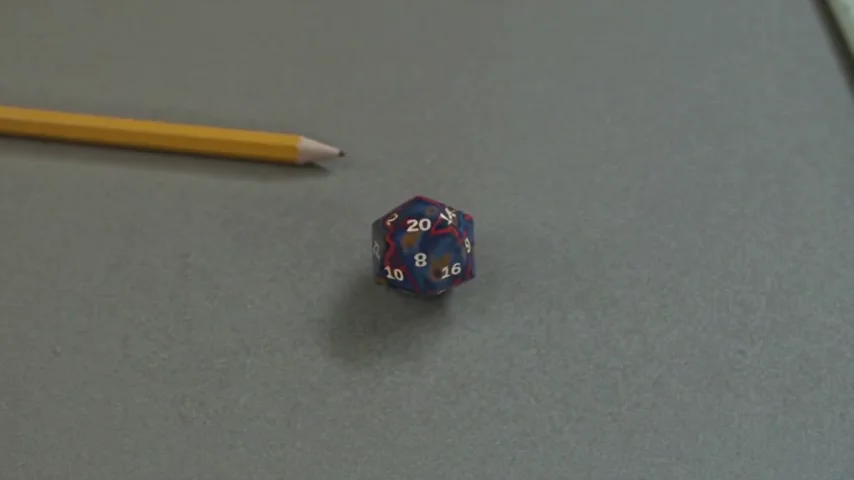
The die was easier to measure. We built a twenty-faced icosahedron, checked that each value appeared once and verified that opposite faces on this model added to 21. A natural 20 and natural 1 were checked at rest. The direct render got the numbers right but its light, contact and perspective sat awkwardly between photographic shots. The final gameplay dice came from generated footage.
Watch both original performances
Both versions received our story, cast, approved artwork, voice material, target lengths and draft settings. A received timed Blender guides. B received no motion-reference movies and could choose its coverage. Each continued from its own results. Here are eight continuous seconds from each raw lift, with native picture and sound. Listen to one at a time. Where is the Gnome’s face when his question begins?
Both prompts requested the cracking ground. B made the rock feel heavier to me because I could see the strain and the crack together. The audio reference already contained this exact question. Hearing it match doesn’t establish whether the same voice would carry into a different line.
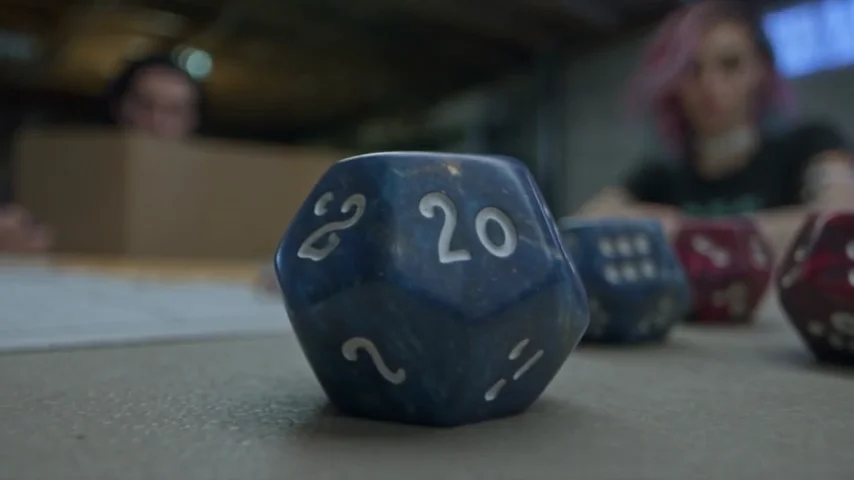
I preferred B’s little smile on the Clever Rebel and A’s move down toward the roll. On the bridge, A offered a convincing pause before the breakup, then restored parts of the bridge during the Raven’s flight. B let the boulder hang beneath the arch. Compare a whole take through its ending before putting a star beside the first few seconds.
Give the best performance room in the edit
Three Resolve timelines let me compare longer selected shots, sustained performances and a faster comedy cut. I chose the faster version and put four seconds back across the final edit. In the Giant’s frontal shot we cropped about 1.42× to remove the distracting hand and paper. His pause after “No” was the best reason to stay. The audio could also lead a cut. The Dungeon Master’s narration came from a later basement performance while the opening castle sweep came from the first pass. The Dexterity check arrives over a pebble, and suddenly that tiny obstacle matters.
Earlier titles tried a rigid die, a direct composite and a motion-conditioned roll. Correcting the number on one face could leave a different number wrong. The final parchment reveal left the decorative die in the lettering and removed the separate foreground roll. The finished episode combines shots from multiple revisions. When comparing A and B above, you are seeing each original before those decisions.
Let the score clear for the question
We auditioned three orchestral recordings after picture lock. I chose Edvard Grieg’s In the Hall of the Mountain King, recorded by Odyssey Orchestra with Eric Jacobsen, through Epidemic Sound. Four stems let us build into the lift and release the music before the Gnome’s dry question. Sliding stone sells the weight. A little grit on the second collapse helps the bridge fail a beat later than you expect. The separate stems stay in the editing project.
Our approved short runs 2,187 frames at 24 fps, including three black frames leading into the title. Promoting nineteen complete generated source takes to native 4K was quoted at 9,442 credits. I chose the zero-additional-credit finish. FFmpeg enlarged the original 854 × 480 imagery and Resolve conformed the locked cut in UHD. The local upscale preserved the approved performances and cuts. In the close-up, you can still see the soft edges from the 480p source. The larger frame contains no additional native detail.
Try one scene of your own
Pick an action whose success a stranger can see, such as a character tipping a heavy box onto a table. Write down the exact hand contact, starting position and resting side. Give both versions the same cast, room, line and target duration. Supply one version with a movement guide. Leave the second version’s framing open. Save each original and listen to each once before measuring it. Mark the frame where the box touches down, then write down which take you would use and why. Those answers might be different.
- Download the blank reference-assignment worksheet (CSV). One row per creative decision, with an authority and a check a viewer can actually perform.
- Download the blank take and credit ledger (CSV). Track approval, estimated and actual charges, continuity, source windows and the edit decision.
For more on camera choices, read Beyond the Prompt. Continue with From Commercial to Cinematic Universe for series continuity or the Higgsfield Yeti creature study for character design.