
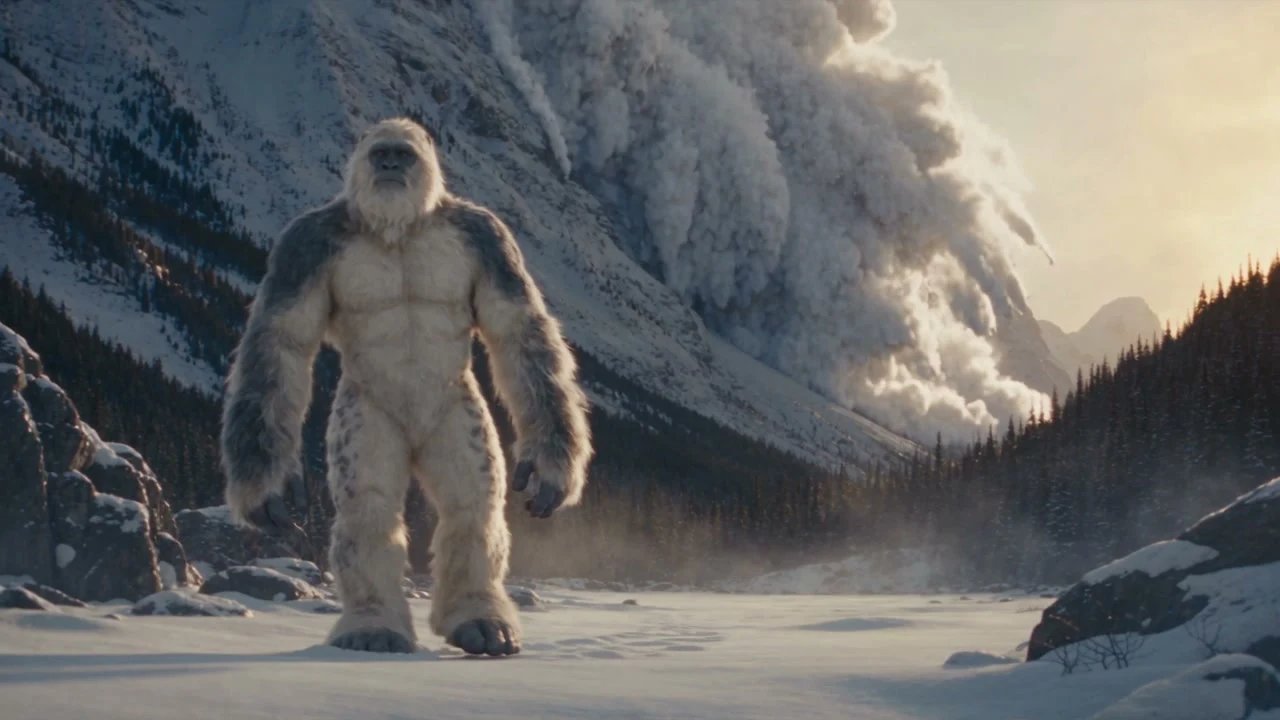
Watch the full experiment
The experiment: a monster with a very small problem
A huge Yeti walks through a snowy mountain pass. An avalanche sends him running. Change the threat to a tiny Chihuahua in a red winter coat, and the same basic action becomes a joke.
That is the filmmaking question behind this project: how much can we direct an AI creature, and how much control remains with the generator? We made an original character, built reference sheets, generated two story variations, then revised the prompts for a sequence of cinematic shots. We also tried a Genjutsu skydiving template and assembled the tutorial in DaVinci Resolve.
The result is a set of finished, rendered clips. It is not a rigged 3D character, a simulated groom or a scene we can reopen and adjust one light at a time. That distinction matters when comparing this workflow with traditional creature effects.
What you will build
- One recognizable Yeti design with a dark face, amber eyes, ivory fur and charcoal shoulders.
- A three-view character sheet, an extended turnaround and an anatomical detail sheet.
- Two original continuous-take generations: avalanche and Chihuahua.
- Two revised cinematic generations that ask for multiple shots.
You will need a Higgsfield account with access to the recorded models, enough credits for iteration, and an editor if you want to assemble your results. The video shows the Plus plan during production. Check the current pricing page and the generation cost displayed in your account before committing credits; this article does not promise a current price or discount.
Tools and settings used in this production
| Stage | Recorded tool | Configuration |
|---|---|---|
| Character | GPT Image 2.5 Flare in Higgsfield | Portrait, 3:4 |
| Reference sheets | GPT Image 2.5 Sunburst | Attach the approved character; 16:9 |
| Main animation | Seedance 2.5 | 15 seconds, 16:9, 720p, generated sound |
| Motion-template experiment | Genjutsu | Community template, character replacement, 720p |
| Editorial | DaVinci Resolve | Tutorial assembly, dialogue edits, generated clips and disclosure |
These are the names and settings recorded for this project, not a guarantee that every future account or model selector will look the same. The source Seedance downloads are 1280 × 720 at 24 fps. The published tutorial is a 1920 × 1080, 30 fps edit; a larger delivery frame does not add native detail to the generated clips.
Create the Yeti: design for recognition
Start in Image → Create image, select GPT Image 2.5 Flare, paste the character prompt, and set 3:4. Read the displayed credit cost before generating. Inspect the finished image before building the sheets.
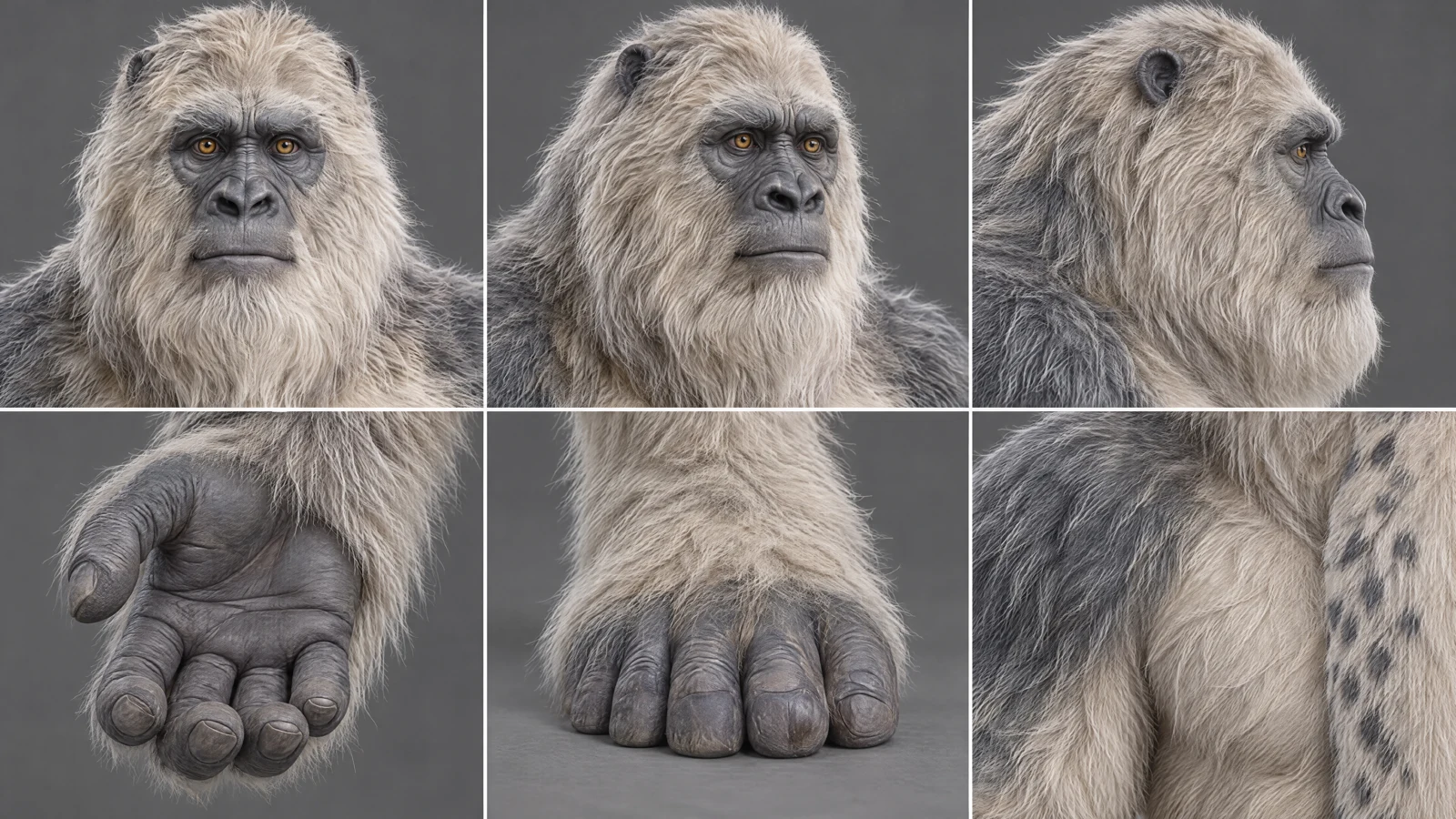
The design uses a few features that remain readable in a snowy environment: a charcoal face surrounded by ivory fur, a heavy brow, amber eyes, very broad shoulders, long arms and darker outer limbs. Those choices give us identity cues beyond “a large white creature.” The prompt’s film-quality language describes the visual target; it is not a measured quality rating.
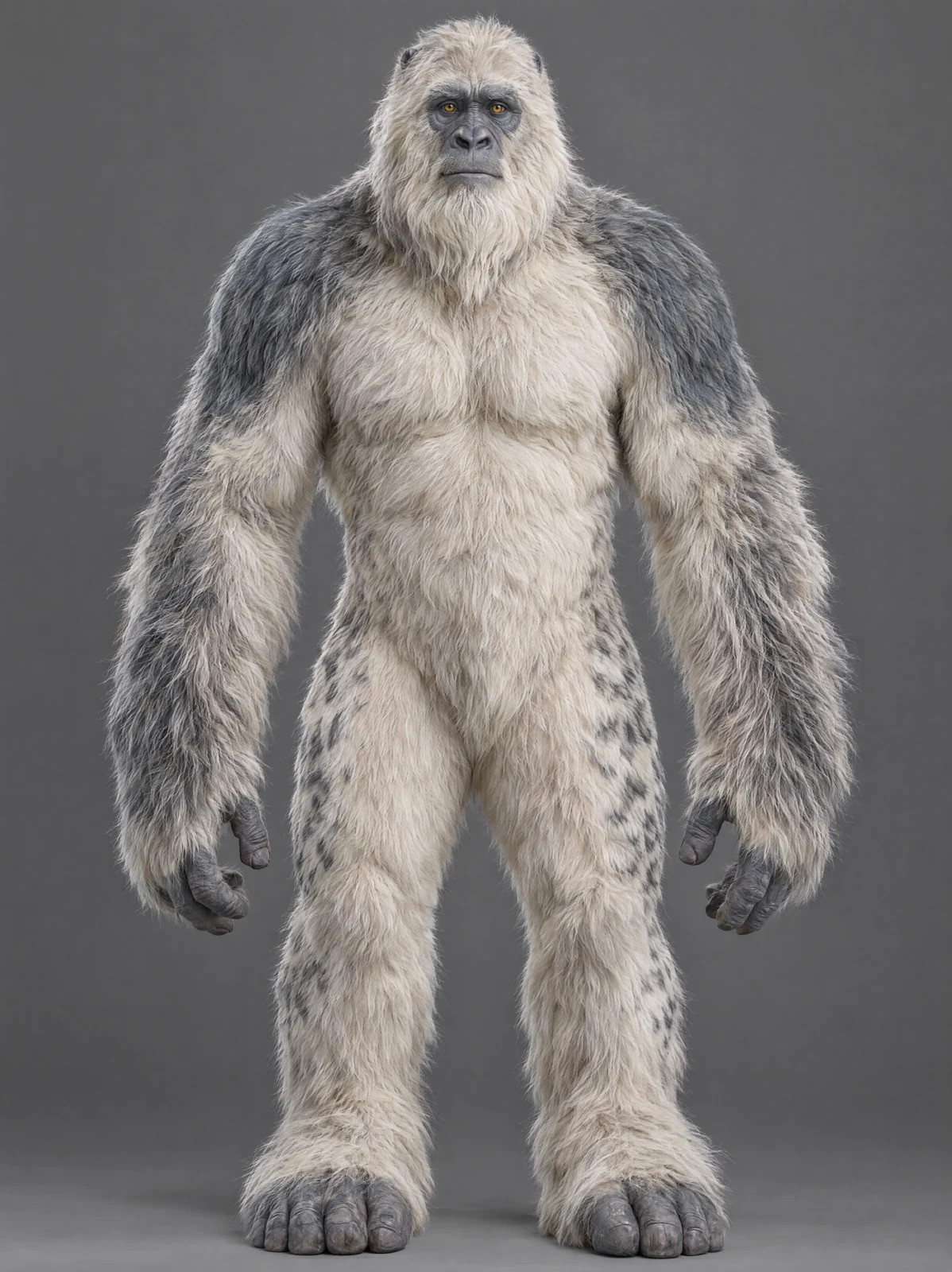
Check the face, hands, feet and whole-body proportions. Keep the approved image as your reference rather than regenerating a new character for each later step. If you use your own photograph instead, use an image you have permission to use.
Build references before asking for movement
Attach the approved character, switch to GPT Image 2.5 Sunburst, set 16:9, and use the three-view sheet prompt. The intended panels are a front view, side profile and face close-up. Inspect each panel against the original; the instruction to preserve identity is a request, not a guarantee.
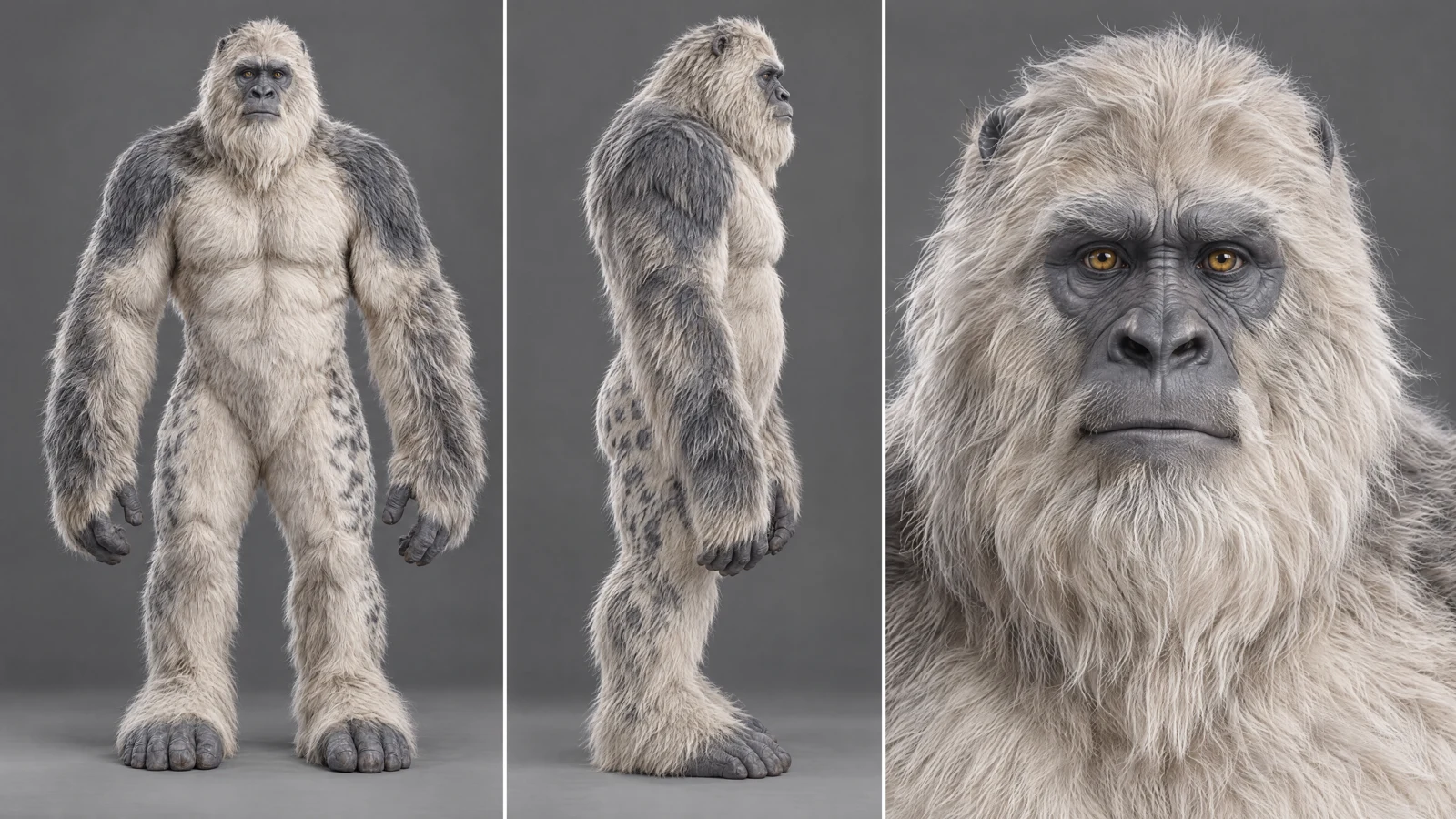
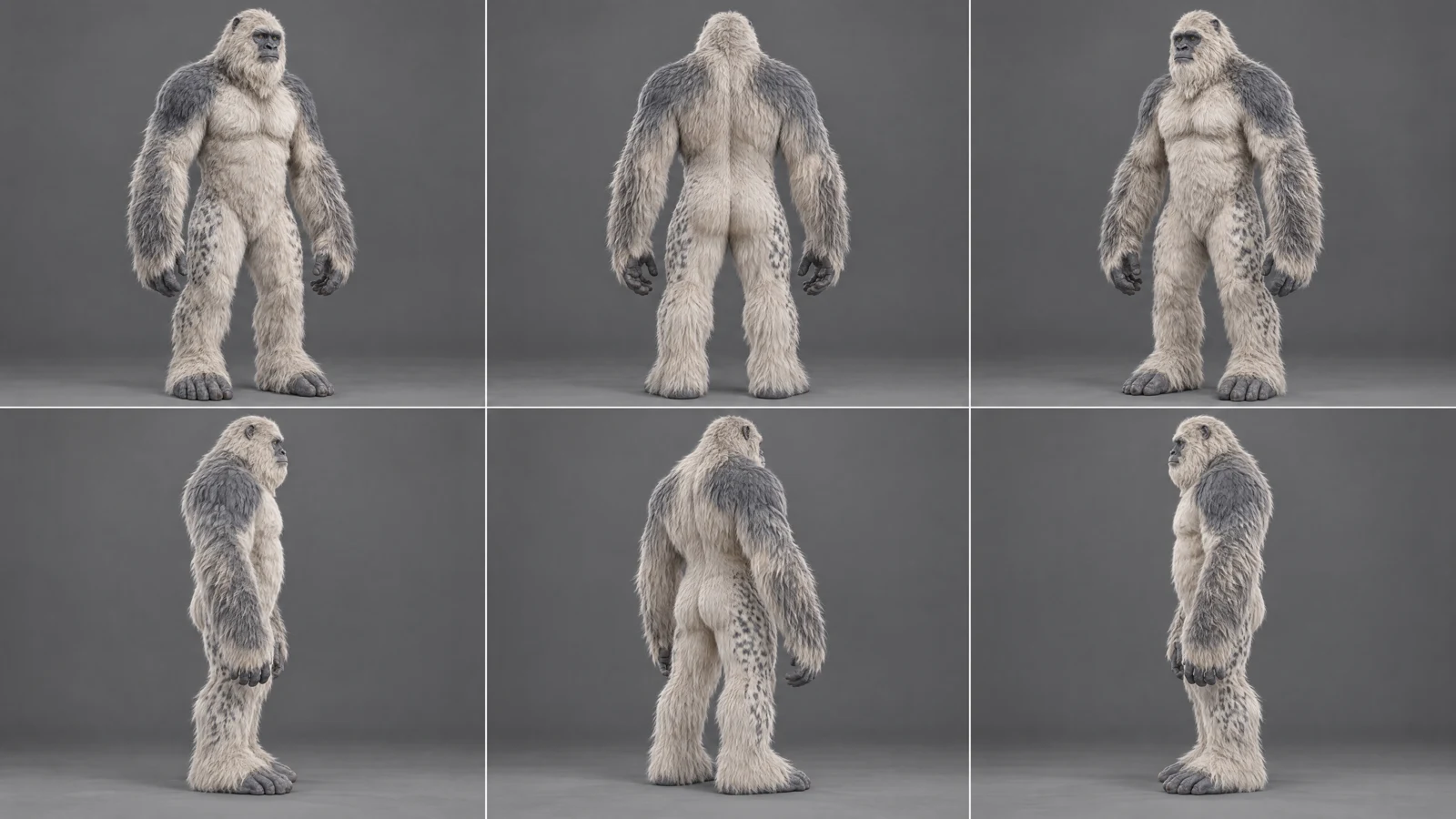
We then made two additional sheets: six body views and anatomical details. The turnaround exposes the back and silhouette. The detail sheet emphasizes the face, hands, feet and fur. These give the video model more visual information; they are not a production-ready 3D model or verified anatomical blueprint.
Generate the original avalanche sequence
Open Video → Create video and choose Seedance 2.5. Add the three sheets as references. In the prompt field, type @ and select each uploaded reference so the names bind to the actual images:
- @Image1: front, side and face sheet.
- @Image2: extended body turnaround.
- @Image3: anatomical detail sheet.
Paste the original avalanche prompt, confirm 15s / 16:9 / 720p, and check the cost on Generate. The tutorial capture shows a 105-credit cost at the generation step. That is an observed cost for this configuration during production, not a promise about future rates.
The prompt separates character identity, environment, camera, action, sound and constraints. It asks for an initially majestic creature, an escalating threat and a panicked fall. The original is a continuous-take concept; keep it separate from the later edited, multi-shot version.
Watch the full result. Does the creature remain recognizable? Can you follow where the avalanche is in relation to the Yeti? Do the feet and hands make convincing contact with the snow? A striking still is only one part of a successful moving shot.
Change the threat: avalanche to Chihuahua
For the second original, keep the same three character references and the same 15-second, widescreen, 720p configuration. Use the original Chihuahua prompt. The story change replaces a large natural threat with a tiny dog wearing a red coat. The Yeti’s disproportionate reaction provides the comedy.
The archived prompts make more than a one-word substitution: the title, threat description, action beats and sound direction change to support the new premise. The exact original A-to-B text comparison is below. This is a creative comparison, not a controlled scientific A/B test; we did not establish a matched seed or lock the camera, environment and timing across the generations.
The second clip changes the emotional reading of the scene even though the character still runs and falls. It also produces different scenery and performance timing. Keep those differences in mind when judging how precisely a prompt edit affected the output.
Revise the cinematography, not just the subject
The next pass uses the cinematic avalanche and cinematic Chihuahua prompts. These ask for an edited sequence rather than a single continuous view: establish the mountains, get close to the creature, reveal the threat, follow the action and end on a reaction.
In the completed files, the wide establishing shots create scale, foot-level shots emphasize weight, and facial close-ups make the panic legible. The dog reveal benefits from its own shot. Shot variety is visible in these outputs; exact timing and continuity still need inspection.
For your own iteration, change a specific directorial intention and write down why: a clearer threat reveal, a lower camera, a more readable reaction. Compare the new result to the old one. A new generation can alter successful elements too, so preserve both files and select deliberately in the edit.
Try Genjutsu motion transfer
The bonus in the published tutorial uses Genjutsu → Community trending → Recreate. It swaps the template character for the original Yeti and selects 720p. Instead of describing all movement through text, this workflow starts from a community motion and camera reference.
Motion transfer can help when the action already exists in a reference. It does not establish ownership of the source, and a result that looks entertaining still needs character, motion and rights review. For a fresh production, choose a reference you are authorized to reuse.
What worked, and what needs inspection
| Area | What this project shows | What it does not establish |
|---|---|---|
| Character consistency | The dark face, amber eyes, ivory torso and charcoal shoulders remain recognizable. | Pixel-identical anatomy, fur or proportions across all frames. |
| Fur | Detailed strands and moving silhouettes create a convincing surface impression in selected shots. | A controllable groom or validated physical fur simulation. |
| Anatomy and body mechanics | The run, panic and fall read clearly at normal speed. | Perfect limb volume, foot contact or weight transfer in every frame. Scrub the falls closely. |
| Snow interaction | Snow spray supports the impact and speed. | A physically verified interaction between feet, snow and body mass. |
| Cinematography | The revised outputs provide establishing shots, lower angles and reaction close-ups. | A repeatable shot list with exact focal length and cut timing. |
| Environment | Snow, peaks and warm/cool light establish a coherent general setting. | One locked mountain geography across regenerated versions. |
| Facial animation | The eyes and open-mouth reactions help communicate panic. | An editable facial rig or direct control over individual expressions. |
| Creative control | Reference images and prompt changes steer identity, threat and shot structure. | Deterministic revisions that preserve every other element. |
The practical lesson is to evaluate the sequence as both an artist and an editor. Look at the first impression, then inspect the transitions, contact points, hands and face. Keep a log of prompt changes and save outputs with version names. Shortlist the strongest result rather than assuming the newest generation is the best.
Can AI replace 3D creature FX?
For this experiment, AI produced useful creature imagery and short animated scenes without a traditional modeling, rigging or animation workflow for those shots. It gave us material to direct, compare and edit.
It did not produce the same deliverables as a traditional creature pipeline. If a production needs a specific foot plant, repeatable lighting, a camera move that must match a plate, separate render passes or revisions across dozens of shots, those are distinct control requirements. This project does not prove that text-to-video satisfies them.
The strongest outcome here is the ability to explore a visual idea and test its story. The avalanche demonstrates danger; the Chihuahua demonstrates contrast. The human decision about what makes that contrast funny still drives the scene.
Complete production prompt library
The eight blocks below preserve the archived production text, including the extended sheets and both original and cinematic video versions. Reference tokens must be bound to your uploaded images in Higgsfield. Long prompts are expandable and individually copyable. Results will vary; these are the prompts from this project, not a guarantee of matching outputs.
Character design
GPT Image 2.5 Flare · 3:4
Read the complete character design prompt
Create an extraordinarily photorealistic, full-body portrait of an original Himalayan Yeti, designed as a major creature character for a high-budget Hollywood feature film.

The creature should feel like a believable, previously undiscovered species adapted to surviving in the extreme Himalayan wilderness. Its design combines overwhelming physical power with an unexpectedly endearing personality.

ANATOMY AND SILHOUETTE

The Yeti stands approximately 10 feet tall, with an imposing, unmistakable silhouette.

He has exceptionally broad, powerful shoulders, a thick muscular chest, long heavy arms, enormous hands, and massive feet adapted for moving through deep snow.

His torso tapers naturally toward moderately narrow but muscular hips. His legs are long, thick, and powerful, with anatomically believable thighs, knees, calves, and ankles.

The proportions are slightly exaggerated but grounded in realistic biomechanics. His enormous upper body creates an intimidating silhouette without making his lower body appear unnaturally thin or weak.

FUR DESIGN AND COLORATION

His body is covered in exceptionally thick, realistic winter fur inspired by the natural adaptations of snow leopards, Eurasian lynx, Arctic wolves, and other cold-weather mammals.

The primary coat is a luxurious combination of ivory white, pale cream, and cool silver-gray.

Distinctive charcoal-gray and slate-blue variations create natural contrast across the coat.

The shoulders and upper arms feature broad, organically blended regions of cool charcoal-gray fur, transitioning gradually into ivory-white fur. These markings resemble natural variations in winter animal coats rather than painted stripes.

The forearms have exceptionally long, flowing, shaggy fur with subtle charcoal-gray variations.

Small, irregular dark-gray spots and subtle mottled markings appear selectively along the outer hips, upper thighs, and lower flanks, inspired by the understated markings of snow leopards.

These markings are sparse and organic, providing visual interest without overwhelming the predominantly white coat.

Do not place spotted patterns across the shoulders or upper chest.

The chest and abdomen feature softer, luxurious ivory fur that contrasts with the darker shoulder markings.

The fur incorporates multiple realistic layers: thick insulating underfur, longer protective guard hairs, natural clumping, subtle color variation, and individual translucent strands.

The result should feel like the genuine winter coat of a massive living animal rather than a theatrical costume.

FACE AND EXPRESSION

The face is the most important part of the design.

He possesses an original, distinctly nonhuman humanoid face with an expressive, intelligent appearance.

His facial features combine a broad, powerful nose, pronounced cheek structure, expressive brow ridges, and a strong jaw.

His skin is deep charcoal-gray with subtle cool blue undertones, visible primarily around the eyes, nose, and mouth.

Most of his face is covered in relatively short, dense ivory-colored fur, transitioning naturally into longer cheek fur and a thick, flowing beard.

His eyes are striking golden amber, with realistic irises and deep, expressive pupils.

His eyebrows are substantial and highly expressive, allowing him to communicate curiosity, confusion, concern, embarrassment, and extreme fear.

Avoid strongly ape-like, feline, canine, or wolf-like facial anatomy. His face must feel unique to this fictional species.

The expression is initially neutral, intelligent, and slightly intimidating, with subtle hints of vulnerability and gentleness.

EARS

The ears are small, rounded, and positioned naturally along the sides of the head.

They sit close against the skull, partially concealed beneath the surrounding fur, blending seamlessly into the head's overall silhouette.

Only the uppermost tips of the ears feature dark charcoal-gray fur.

The darker coloration does not extend down the sides of the face.

The ears should feel like a natural anatomical feature rather than separate pointed animal ears attached to the head.

PERSONALITY

Despite his imposing appearance, the Yeti possesses a gentle, slightly awkward personality.

His design should support a wide range of expressive physical performances, particularly exaggerated surprise, confusion, nervousness, and comical terror.

He should appear capable of effortlessly overpowering enormous predators while simultaneously possessing the emotional vulnerability to become absolutely terrified of a tiny Chihuahua.

The humor must emerge from the contrast between his intimidating physical presence and his unexpectedly timid personality.

Avoid overt cartoon exaggeration.

POSE AND PRESENTATION

The Yeti stands upright in a relaxed, symmetrical neutral pose, facing directly toward the camera.

His powerful arms hang naturally away from his torso, with both hands clearly visible.

Both enormous feet rest firmly on the ground.

His facial expression is neutral, mouth closed, eyes directed toward the viewer.

Show his entire body from the top of his head to the bottom of his feet, with generous framing around the silhouette.

LIGHTING AND RENDERING

Professional Hollywood creature-design reference photography.

Soft, balanced studio lighting reveals the exceptional complexity of the fur, subtle differences in color and value, and realistic three-dimensional anatomy.

Gentle rim lighting separates the pale fur from the background.

Ultra-realistic skin texture, physically accurate fur scattering, subsurface scattering, detailed grooming, and sophisticated cinematic rendering.

The creature should appear indistinguishable from a real, living animal photographed on a professional film production stage.

BACKGROUND

A seamless neutral medium-gray studio background with a subtle contact shadow beneath the feet.

Full-body vertical 3:4 composition.

No mountains, snow, environment, clothing, accessories, props, text, or other characters.

IMPORTANT DESIGN RESTRICTIONS

Preserve the recognizable golden eyes, broad shoulders, powerful natural proportions, dense ivory coat, charcoal-gray shoulder variations, subtle spotted thigh markings, dark blue-gray facial skin, and small rounded ears.

Avoid excessively dark fur, heavy leopard spotting, pointed animal ears, exaggerated primate features, feline or canine muzzles, overly thin legs, unnatural anatomy, cartoon proportions, or aggressive snarling.

The final design should feel distinctive, majestic, believable, and unexpectedly lovable.
Three-view character sheet
16:9; attach original approved Yeti portrait.
Read the complete three-view character sheet prompt
Using the attached image as the definitive character reference, create a professional photorealistic creature-effects character sheet featuring the EXACT SAME Yeti.

Arrange the character sheet into three clearly separated panels:

PANEL 1 — FULL-BODY FRONT VIEW

The Yeti standing upright, facing directly toward the camera, neutral expression, arms hanging naturally at its sides. Show the entire body, including head, hands, and feet.

PANEL 2 — FULL-BODY SIDE PROFILE

The identical Yeti viewed from exactly 90 degrees to the left. Maintain the same anatomy, height, proportions, fur distribution, body mass, and facial structure. Show the entire body from head to feet.

PANEL 3 — FACIAL CLOSE-UP

A detailed frontal portrait of the Yeti's face and upper shoulders, showing its distinctive charcoal-gray facial skin, deep-set amber eyes, broad nose, substantial brow structure, mouth, and surrounding ivory fur.

CHARACTER CONSISTENCY — CRITICAL

Preserve the exact visual identity established in the reference image:

- Massive shoulders and exceptionally long arms.
- Thick ivory-white fur across the chest, torso, and legs.
- Darker gray fur across the shoulders and outer arms.
- Subtle mottled gray markings on the outer thighs.
- Large charcoal-gray hands and feet.
- Distinctive charcoal-gray primate-like face.
- Deep-set amber eyes.
- Dense, layered fur with realistic individual strands.
- Identical head shape, facial anatomy, and body proportions.

Do not redesign, reinterpret, beautify, or stylize the character.

Maintain a neutral, relaxed expression across all views.

PRESENTATION

Professional Hollywood creature-effects reference photography.

Neutral gray seamless studio background, consistent soft lighting, physically realistic fur grooming and skin materials.

Clean, organized three-panel layout in a 16:9 horizontal composition.

Ensure the full-body views are completely visible without cropping.

No text, labels, logos, watermarks, additional characters, or decorative elements.
Extended turnaround
16:9; reference existing Yeti images.
Read the complete extended turnaround prompt
Using the attached character images as definitive visual references, create an extremely detailed, photorealistic, professional creature-effects character turnaround sheet of the EXACT SAME Yeti.

This is an extension of an existing character design, NOT a redesign.

CHARACTER IDENTITY — ABSOLUTELY CRITICAL

Maintain the precise appearance of the reference creature:

- Massive, muscular humanoid build with exceptionally broad shoulders.
- Approximately 10-foot-tall proportions.
- Long, powerful arms extending toward the knees.
- Heavy upper torso, comparatively narrower waist, and thick muscular legs.
- Shaggy ivory-white fur across the head, chest, abdomen, and legs.
- Distinctive charcoal-gray fur covering the shoulders and upper arms.
- Irregular gray spotted markings along the outer thighs.
- Charcoal-gray hands and feet with detailed leathery skin.
- Distinctive primate-like face with charcoal-gray skin.
- Deep-set amber eyes, pronounced brow ridges, broad nose, and powerful jaw.
- Small, naturally integrated rounded ears.
- Long, layered, individually distinguishable fur strands.

Preserve the character's exact facial proportions, anatomy, distinctive markings, and overall silhouette.

REFERENCE SHEET LAYOUT

Create SIX individual full-body reference views arranged in a clean 3-column × 2-row grid.

TOP ROW:

Panel 1: Front three-quarter view, rotated approximately 45 degrees toward the character's left.

Panel 2: Exact full-body rear view, revealing the back anatomy, shoulder musculature, fur distribution, and leg markings.

Panel 3: Front three-quarter view, rotated approximately 45 degrees toward the character's right.

BOTTOM ROW:

Panel 4: Exact full-body left profile.

Panel 5: Rear three-quarter view, approximately 45 degrees from behind.

Panel 6: Exact full-body right profile.

POSE CONSISTENCY

The creature maintains the same neutral, relaxed standing pose in every panel.

Arms hang naturally beside the torso, slightly separated from the body.

Hands remain relaxed with fingers visible.

Both feet are planted firmly on the ground.

Neutral facial expression, mouth closed.

All views must show the entire creature from the top of its head to the soles of its feet.

TECHNICAL REQUIREMENTS

Use identical character proportions and consistent studio lighting across all six views.

Orthographic-style camera framing with minimal perspective distortion.

Consistent apparent character height across panels.

No changes in body shape, fur grooming, facial structure, or markings between views.

Use a neutral medium-gray seamless background.

Professional feature-film creature-effects reference photography.

Extremely detailed fur grooming, physically realistic skin materials, natural anatomical structure, and high-quality cinematic rendering.

Clean white or subtle gray panel separators.

COMPOSITION

Horizontal 16:9 reference sheet.

Six evenly sized panels with clean spacing.

The creature must remain completely visible within every panel.

No text, labels, annotations, logos, watermarks, additional characters, clothing, or accessories.
Anatomical detail sheet
16:9; reference existing Yeti images.
Read the complete anatomical detail sheet prompt
Create an extremely detailed, photorealistic creature-effects anatomical reference sheet featuring the EXACT SAME Yeti from the attached reference images.

This is a professional production reference for creature animation, facial performance, fur grooming, and visual-effects development.

Preserve the creature's identity exactly. Do not redesign, reinterpret, or modify its anatomy.

LAYOUT

Create six detailed close-up reference images arranged in a clean 3-column × 2-row grid.

PANEL 1 — FRONT FACIAL ANATOMY

Extreme detailed frontal portrait showing the Yeti's face.

Neutral expression.

Clearly show the deep-set amber eyes, prominent brows, forehead wrinkles, charcoal-gray skin, broad nose, mouth, and facial proportions.

Reveal individual facial hairs and the transition between exposed facial skin and surrounding ivory fur.

PANEL 2 — THREE-QUARTER FACIAL ANATOMY

Detailed three-quarter view of the identical face.

Emphasize the depth of the brow ridges, muzzle structure, cheekbones, jaw, and small rounded ears.

Preserve the exact facial proportions from the reference.

PANEL 3 — SIDE FACIAL PROFILE

Detailed 90-degree side-profile portrait.

Clearly reveal the forehead slope, nose projection, muzzle, chin, jawline, ear anatomy, and layered facial fur.

PANEL 4 — HAND ANATOMY

Detailed close-up of one enormous Yeti hand.

Show the palm and fingers clearly, with realistic joints, knuckles, nails, wrinkles, and leathery charcoal-gray skin.

Include the natural transition from dense forearm fur to exposed hand skin.

PANEL 5 — FOOT ANATOMY

Detailed close-up of one enormous Yeti foot.

Show broad toes, realistic nails, heavy anatomical structure, thick leathery skin, and the transition from shaggy leg fur to the foot.

The anatomy should communicate the weight and physical power of a massive bipedal creature.

PANEL 6 — FUR GROOMING AND BODY DETAILS

Detailed close-up showing the transition between charcoal-gray shoulder fur and ivory-white chest fur.

Reveal multiple layers of fur with natural variation in strand length, direction, density, and coloration.

Include visible examples of the distinctive darker mottled fur markings from the character's outer thighs.

VISUAL CONSISTENCY

Maintain identical fur colors, skin texture, facial anatomy, proportions, and materials across all panels.

Photorealistic, feature-film-quality creature-effects reference photography.

Soft, neutral studio lighting designed to reveal fine details.

Consistent medium-gray backgrounds.

COMPOSITION

Horizontal 16:9 format.

Six clearly separated, equally sized panels.

Each panel should prioritize large, clearly visible anatomical details.

No text, labels, watermarks, decorative elements, clothing, or additional characters.
Original avalanche
Seedance 2.5, 15 seconds, 16:9, 720p, audio. References @Image1–3.
Read the complete original avalanche prompt
CINEMATIC CREATURE FX — YETI ENCOUNTERS AN AVALANCHE

CHARACTER REFERENCES

@Image1 is the primary character reference, showing the Yeti's full-body front view, side profile, and facial close-up.

@Image2 provides additional views of the exact same Yeti, establishing its anatomy, silhouette, proportions, and fur distribution.

@Image3 provides detailed references of the same Yeti's face, hands, feet, skin textures, and fur grooming.

All three references depict ONE IDENTICAL CHARACTER, not three different creatures.

Preserve the Yeti's distinctive appearance throughout the entire sequence: massive muscular frame, enormous shoulders, exceptionally long arms, shaggy ivory-white fur, charcoal-gray shoulder fur, spotted thigh markings, dark leathery hands and feet, charcoal-gray primate-like face, and expressive amber eyes.

The creature must remain anatomically consistent, recognizable, and photorealistic.

ENVIRONMENT

A breathtaking, remote Himalayan mountain pass during late-winter golden hour.

An expansive snow-covered mountain trail winds through rugged alpine terrain, surrounded by towering jagged peaks, dark evergreen forests, enormous weathered rock formations, and deep snowbanks.

The distant mountains have tremendous scale and atmospheric depth.

The weather is cold and mostly clear, with gentle drifting snow, occasional wind gusts, and subtle atmospheric haze.

The low winter sun illuminates the mountain landscape with soft golden light, while the snow-covered terrain retains rich, cool blue-gray shadows.

The environment feels beautiful, remote, peaceful, and slightly dangerous.

CINEMATOGRAPHY

Photorealistic, feature-film-quality creature cinematography.

35mm cinematic lens with natural perspective and realistic depth.

One continuous, uninterrupted tracking shot.

The camera is positioned slightly below the Yeti's chest level, looking upward from a front three-quarter angle to emphasize the creature's enormous scale.

The camera smoothly tracks backward as the Yeti advances along the snowy mountain trail.

Maintain enough distance to show the Yeti's entire body, its physical performance, and the surrounding mountain environment.

Keep the mountainside behind the Yeti visible so the approaching threat can be clearly established.

Use natural cinematic composition, realistic depth of field, restrained camera movement, and subtle environmental atmosphere.

No cuts, sudden camera transitions, excessive zooming, or artificial slow motion.

LIGHTING

Cold winter golden-hour cinematography.

A low, warm sun creates beautiful golden rim lighting along the Yeti's shoulders, head, and individual fur strands.

Soft, cool blue ambient light fills the shadowed areas of its body.

The contrasting warm highlights and cool shadows reveal the creature's three-dimensional anatomy and detailed fur grooming.

The Yeti's charcoal-gray face and amber eyes remain clearly readable.

Maintain consistent lighting throughout the sequence.

Avoid excessive orange color grading, blown-out snow, or deep shadows that obscure the character.

STORY AND PERFORMANCE

BEGINNING — 0–4 SECONDS: CONFIDENCE

The enormous Yeti walks confidently along the snowy mountain trail.

Its movements are slow, deliberate, powerful, and majestic.

Every enormous footstep compresses the deep snow, leaving visible footprints.

Its long, shaggy fur responds naturally to the cold mountain breeze.

The creature appears completely comfortable and fearless in its environment.

The camera smoothly tracks backward, emphasizing the Yeti's imposing silhouette against the spectacular alpine landscape.

The atmosphere is peaceful, cinematic, and grand.

MIDDLE — 4–7 SECONDS: THE THREAT

Suddenly, a massive avalanche breaks loose high on the mountainside behind the Yeti, toward screen-right.

An enormous wall of snow and ice begins cascading down the steep mountain slope.

A deep, thunderous rumble echoes through the valley as the avalanche gains speed, throwing enormous clouds of powdered snow into the air.

The Yeti hears the approaching destruction.

It abruptly stops walking, turns its head over its right shoulder, and discovers the enormous avalanche rushing toward it.

Its confident expression transforms into absolute terror.

ENDING — 7–15 SECONDS: PANIC AND PAYOFF

The terrified Yeti suddenly bolts forward, running frantically toward the camera.

Its powerful legs drive through the snow, throwing powder into the air.

Its enormous arms swing wildly, and its long shaggy fur reacts dynamically to the sudden acceleration.

Despite its intimidating size, the creature now looks completely overwhelmed by fear.

As it attempts to escape, one enormous foot loses traction on the slippery trail.

The Yeti stumbles, flails its arms in a desperate attempt to recover, and crashes face-first into a deep snowbank.

Snow erupts around its body.

The creature briefly remains buried in the snow.

It then raises its head, revealing its charcoal-gray face covered with scattered snow.

Its amber eyes are wide with absolute terror.

Hold on this expression for the final moments, allowing the audience to register the creature's fear.

CREATURE FX AND PHYSICAL PERFORMANCE

Prioritize physically convincing creature animation.

The Yeti must communicate enormous mass, muscular weight, believable acceleration, and convincing inertia.

Maintain accurate foot contact with the snowy terrain.

Footsteps should visibly compress and displace snow.

Its massive arms, torso, and legs should move with plausible anatomical coordination.

The creature's long fur should respond naturally to movement, wind, sudden acceleration, and the impact of falling into the snow.

Preserve consistent anatomy, facial structure, fur distribution, and character identity throughout the entire shot.

Facial animation should clearly communicate the transformation from confidence to sudden terror.

Environmental effects should respond believably to the creature's physical actions.

The final result should resemble a high-budget Hollywood creature-effects sequence rather than a cartoon animation.

SOUND DESIGN

Generate synchronized cinematic environmental audio.

Begin with quiet alpine wind, subtle atmospheric ambience, and the heavy, muffled crunch of the Yeti's enormous footsteps in the snow.

As the threat appears, introduce its distinctive sounds naturally, as described in the middle section.

The Yeti reacts with a startled, deep guttural gasp.

Its frantic footsteps grow louder as it begins running.

The fall produces a heavy, muffled impact and the sound of displaced snow.

Finish with the Yeti's frightened breathing and subtle mountain ambience.

Natural sound effects only.

No music, dialogue, narration, subtitles, text, or logos.

FINAL CREATIVE DIRECTION

The sequence must have a clearly readable beginning, middle, and end.

Build the emotional progression through four distinct stages:

CALM CONFIDENCE → SUDDEN DANGER → EXPLOSIVE PANIC → HELPLESS REACTION.

The opening should feel majestic and cinematic.

The threat should introduce sudden dramatic tension.

The creature's reaction should feel immediate and emotionally readable.

The ending should allow a brief moment of stillness after the frantic action.

The creature must remain visually impressive and physically believable throughout the sequence.

One continuous cinematic shot.

Photorealistic creature FX.

15-second duration.

16:9 widescreen composition.

720p generation.
Original Chihuahua
Seedance 2.5, 15 seconds, 16:9, 720p, audio. References @Image1–3.
Read the complete original chihuahua prompt
CINEMATIC CREATURE FX — YETI ENCOUNTERS A CHIHUAHUA

CHARACTER REFERENCES

@Image1 is the primary character reference, showing the Yeti's full-body front view, side profile, and facial close-up.

@Image2 provides additional views of the exact same Yeti, establishing its anatomy, silhouette, proportions, and fur distribution.

@Image3 provides detailed references of the same Yeti's face, hands, feet, skin textures, and fur grooming.

All three references depict ONE IDENTICAL CHARACTER, not three different creatures.

Preserve the Yeti's distinctive appearance throughout the entire sequence: massive muscular frame, enormous shoulders, exceptionally long arms, shaggy ivory-white fur, charcoal-gray shoulder fur, spotted thigh markings, dark leathery hands and feet, charcoal-gray primate-like face, and expressive amber eyes.

The creature must remain anatomically consistent, recognizable, and photorealistic.

ENVIRONMENT

A breathtaking, remote Himalayan mountain pass during late-winter golden hour.

An expansive snow-covered mountain trail winds through rugged alpine terrain, surrounded by towering jagged peaks, dark evergreen forests, enormous weathered rock formations, and deep snowbanks.

The distant mountains have tremendous scale and atmospheric depth.

The weather is cold and mostly clear, with gentle drifting snow, occasional wind gusts, and subtle atmospheric haze.

The low winter sun illuminates the mountain landscape with soft golden light, while the snow-covered terrain retains rich, cool blue-gray shadows.

The environment feels beautiful, remote, peaceful, and slightly dangerous.

CINEMATOGRAPHY

Photorealistic, feature-film-quality creature cinematography.

35mm cinematic lens with natural perspective and realistic depth.

One continuous, uninterrupted tracking shot.

The camera is positioned slightly below the Yeti's chest level, looking upward from a front three-quarter angle to emphasize the creature's enormous scale.

The camera smoothly tracks backward as the Yeti advances along the snowy mountain trail.

Maintain enough distance to show the Yeti's entire body, its physical performance, and the surrounding mountain environment.

Keep the mountainside behind the Yeti visible so the approaching threat can be clearly established.

Use natural cinematic composition, realistic depth of field, restrained camera movement, and subtle environmental atmosphere.

No cuts, sudden camera transitions, excessive zooming, or artificial slow motion.

LIGHTING

Cold winter golden-hour cinematography.

A low, warm sun creates beautiful golden rim lighting along the Yeti's shoulders, head, and individual fur strands.

Soft, cool blue ambient light fills the shadowed areas of its body.

The contrasting warm highlights and cool shadows reveal the creature's three-dimensional anatomy and detailed fur grooming.

The Yeti's charcoal-gray face and amber eyes remain clearly readable.

Maintain consistent lighting throughout the sequence.

Avoid excessive orange color grading, blown-out snow, or deep shadows that obscure the character.

STORY AND PERFORMANCE

BEGINNING — 0–4 SECONDS: CONFIDENCE

The enormous Yeti walks confidently along the snowy mountain trail.

Its movements are slow, deliberate, powerful, and majestic.

Every enormous footstep compresses the deep snow, leaving visible footprints.

Its long, shaggy fur responds naturally to the cold mountain breeze.

The creature appears completely comfortable and fearless in its environment.

The camera smoothly tracks backward, emphasizing the Yeti's imposing silhouette against the spectacular alpine landscape.

The atmosphere is peaceful, cinematic, and grand.

MIDDLE — 4–7 SECONDS: THE THREAT

Suddenly, a ridiculously tiny tan Chihuahua wearing a bright red quilted winter coat emerges from behind a snow-covered rock beside the trail, toward screen-right.

The little dog is comically small compared to the enormous Yeti, barely reaching the creature's ankles.

Despite its miniature size and adorable winter clothing, the Chihuahua behaves like an absolutely ferocious predator.

Its tiny body bounces with exaggerated confidence as it aggressively barks at the enormous creature.

Its ears stand upright, its little paws stamp against the snow, and its sharp, high-pitched barking echoes through the peaceful mountain pass.

The Yeti hears the barking.

It abruptly stops walking, turns its head over its right shoulder, and discovers the tiny Chihuahua staring it down.

Its confident expression transforms into absolute terror.

ENDING — 7–15 SECONDS: PANIC AND PAYOFF

The terrified Yeti suddenly bolts forward, running frantically toward the camera.

Its powerful legs drive through the snow, throwing powder into the air.

Its enormous arms swing wildly, and its long shaggy fur reacts dynamically to the sudden acceleration.

Despite its intimidating size, the creature now looks completely overwhelmed by fear.

As it attempts to escape, one enormous foot loses traction on the slippery trail.

The Yeti stumbles, flails its arms in a desperate attempt to recover, and crashes face-first into a deep snowbank.

Snow erupts around its body.

The creature briefly remains buried in the snow.

It then raises its head, revealing its charcoal-gray face covered with scattered snow.

Its amber eyes are wide with absolute terror.

Hold on this expression for the final moments, allowing the audience to register the creature's fear and the absurdity of the situation.

CREATURE FX AND PHYSICAL PERFORMANCE

Prioritize physically convincing creature animation.

The Yeti must communicate enormous mass, muscular weight, believable acceleration, and convincing inertia.

Maintain accurate foot contact with the snowy terrain.

Footsteps should visibly compress and displace snow.

Its massive arms, torso, and legs should move with plausible anatomical coordination.

The creature's long fur should respond naturally to movement, wind, sudden acceleration, and the impact of falling into the snow.

Preserve consistent anatomy, facial structure, fur distribution, and character identity throughout the entire shot.

Facial animation should clearly communicate the transformation from confidence to sudden terror.

Environmental effects should respond believably to the creature's physical actions.

The final result should resemble a high-budget Hollywood creature-effects sequence rather than a cartoon animation.

SOUND DESIGN

Generate synchronized cinematic environmental audio.

Begin with quiet alpine wind, subtle atmospheric ambience, and the heavy, muffled crunch of the Yeti's enormous footsteps in the snow.

As the threat appears, introduce its distinctive sounds naturally, as described in the middle section.

The Yeti reacts with a startled, deep guttural gasp.

Its frantic footsteps grow louder as it begins running.

The fall produces a heavy, muffled impact and the sound of displaced snow.

Finish with the Yeti's frightened breathing and subtle mountain ambience.

Natural sound effects only.

No music, dialogue, narration, subtitles, text, or logos.

FINAL CREATIVE DIRECTION

The sequence must have a clearly readable beginning, middle, and end.

Build the emotional progression through four distinct stages:

CALM CONFIDENCE → SUDDEN DANGER → EXPLOSIVE PANIC → HELPLESS REACTION.

The opening should feel majestic and cinematic.

The threat should introduce sudden dramatic tension.

The creature's reaction should feel immediate and emotionally readable.

The ending should allow a brief moment of stillness after the frantic action.

The creature must remain visually impressive and physically believable throughout the sequence.

One continuous cinematic shot.

Photorealistic creature FX.

15-second duration.

16:9 widescreen composition.

720p generation.
Cinematic avalanche
Seedance 2.5, 15 seconds, 16:9, 720p, audio. References @Image1–3.
Read the complete cinematic avalanche prompt
# CINEMATIC CREATURE FX — YETI VS AVALANCHE — EDITED SEQUENCE

@Image1 is the primary character reference, showing the Yeti's full-body front view, side profile, and facial close-up.

@Image2 provides additional views of the exact same Yeti, establishing its anatomy, silhouette, proportions, and fur distribution.

@Image3 provides detailed references of the same Yeti's face, hands, feet, skin textures, and fur grooming.

All three references depict ONE IDENTICAL CHARACTER, not three different creatures.

Preserve the Yeti’s distinctive appearance throughout the entire sequence: massive muscular frame, enormous shoulders, exceptionally long arms, shaggy ivory-white fur, charcoal-gray shoulder fur, spotted thigh markings, dark leathery hands and feet, charcoal-gray primate-like face, and expressive amber eyes.

The creature must remain anatomically consistent, recognizable, and photorealistic.

## ENVIRONMENT

A breathtaking remote Himalayan mountain pass during late-winter golden hour.

An expansive snow-covered mountain trail winds through rugged alpine terrain, surrounded by towering jagged peaks, dark evergreen forests, weathered rock formations, and deep snowbanks.

The weather is cold and mostly clear, with drifting snow, occasional wind gusts, subtle atmospheric haze, and visible breath.

The low winter sun creates soft golden highlights while the snow and shadows remain cool blue-gray.

The environment feels beautiful, remote, cinematic, and slightly dangerous.

## VISUAL STYLE

Photorealistic high-end Hollywood creature FX.
Feature-film-quality cinematography.
Natural dramatic pacing.
The sequence should feel like a professionally edited mini scene with multiple shots and clean cuts, not a single unbroken take.

Use cinematic continuity between shots so the Yeti, environment, lighting, and geography remain coherent.

## SHOT STRUCTURE

Create a 15-second edited sequence with multiple cinematic shots and clear cuts.

### SHOT 1 — ESTABLISHING WIDE SHOT — 0:00–0:02
A wide cinematic establishing shot of the snowy mountain pass at golden hour.

The Yeti walks confidently along the trail, small enough in frame to appreciate the scale of the mountains, forests, and environment.

Its silhouette should look large and powerful against the landscape.

### SHOT 2 — LOW-ANGLE FEET CLOSE-UP — 0:02–0:03.5
A dramatic close-up of the Yeti’s enormous feet stomping through deep snow.

Each step compresses the snow heavily and leaves visible footprints.

Snow kicks outward with each footfall.

### SHOT 3 — LOW HERO SHOT — 0:03.5–0:05.5
A low-angle medium shot looking slightly upward at the Yeti from the front three-quarter angle.

The Yeti appears majestic, powerful, and fearless.

Its shaggy fur moves naturally in the cold wind, and warm rim light catches the fur on its shoulders and head.

### SHOT 4 — THREAT REVEAL — 0:05.5–0:07.5
Cut to a wider shot where a massive avalanche suddenly breaks loose on the mountainside behind the Yeti, toward screen-right.

An enormous wall of snow and ice cascades down the slope.

Powder explodes into the air and a thunderous rumble fills the valley.

The Yeti stops and turns to notice it.

Its expression changes from calm confidence to sudden terror.

### SHOT 5 — PANIC RUN — 0:07.5–0:11
A dynamic medium-wide tracking shot as the terrified Yeti runs toward camera in a frantic panic.

Its powerful legs drive through the snow, arms swing wildly, and long fur reacts dynamically to its movement.

Despite its size, it now looks overwhelmed with fear.

### SHOT 6 — THE FALL — 0:11–0:13
A dramatic action shot as one of the Yeti’s feet slips on the snowy trail.

It stumbles, flails, and crashes face-first into a deep snowbank.

Snow erupts around the impact.

### SHOT 7 — REACTION CLOSE-UP — 0:13–0:15
A close-up of the Yeti lifting its head out of the snow.

Its face is dusted with snow and its amber eyes are wide with absolute terror.

Hold on the frightened expression long enough for the audience to clearly read the emotion.

## CREATURE FX AND PERFORMANCE

Prioritize believable creature animation.

The Yeti must feel enormous, heavy, muscular, and physically convincing.

Maintain accurate foot contact and believable body weight.

Snow should react naturally to footsteps, running, slipping, and impact.

The fur should respond realistically to wind, movement, and sudden acceleration.

Facial animation should clearly show the transition from calm confidence to shocked panic.

Preserve the Yeti’s character identity throughout all shots.

## SOUND DESIGN

Generate synchronized cinematic environmental audio.

Use cold alpine wind, deep footstep crunches in snow, distant mountain ambience, avalanche rumble, a startled guttural Yeti reaction, frantic running sounds, snow displacement, and a heavy snowy impact.

No dialogue, no music, no subtitles, no on-screen text, and no logos.

## FINAL DIRECTION

This should feel like a polished, cinematic creature scene with multiple edited shots and clear visual storytelling.

The emotional progression should be:
MAJESTIC CONFIDENCE → SUDDEN DANGER → EXPLOSIVE PANIC → HELPLESS REACTION.

15 seconds.
16:9 widescreen.
720p.
Cinematic Chihuahua
Seedance 2.5, 15 seconds, 16:9, 720p, audio. References @Image1–3.
Read the complete cinematic chihuahua prompt
# CINEMATIC CREATURE FX — YETI VS CHIHUAHUA — EDITED SEQUENCE

@Image1 is the primary character reference, showing the Yeti's full-body front view, side profile, and facial close-up.

@Image2 provides additional views of the exact same Yeti, establishing its anatomy, silhouette, proportions, and fur distribution.

@Image3 provides detailed references of the same Yeti's face, hands, feet, skin textures, and fur grooming.

All three references depict ONE IDENTICAL CHARACTER, not three different creatures.

Preserve the Yeti’s distinctive appearance throughout the entire sequence: massive muscular frame, enormous shoulders, exceptionally long arms, shaggy ivory-white fur, charcoal-gray shoulder fur, spotted thigh markings, dark leathery hands and feet, charcoal-gray primate-like face, and expressive amber eyes.

The creature must remain anatomically consistent, recognizable, and photorealistic.

## ENVIRONMENT

A breathtaking remote Himalayan mountain pass during late-winter golden hour.

An expansive snow-covered mountain trail winds through rugged alpine terrain, surrounded by towering jagged peaks, dark evergreen forests, weathered rock formations, and deep snowbanks.

The weather is cold and mostly clear, with drifting snow, occasional wind gusts, subtle atmospheric haze, and visible breath.

The low winter sun creates soft golden highlights while the snow and shadows remain cool blue-gray.

The environment feels beautiful, remote, cinematic, and slightly dangerous.

## VISUAL STYLE

Photorealistic high-end Hollywood creature FX.
Feature-film-quality cinematography.
Natural dramatic pacing.
The sequence should feel like a professionally edited mini scene with multiple shots and clean cuts, not a single unbroken take.

Use cinematic continuity between shots so the Yeti, environment, lighting, and geography remain coherent.

## SHOT STRUCTURE

Create a 15-second edited sequence with multiple cinematic shots and clear cuts.

### SHOT 1 — ESTABLISHING WIDE SHOT — 0:00–0:02
A wide cinematic establishing shot of the snowy mountain pass at golden hour.

The Yeti walks confidently along the trail, small enough in frame to appreciate the scale of the mountains, forests, and environment.

Its silhouette should look large and powerful against the landscape.

### SHOT 2 — LOW-ANGLE FEET CLOSE-UP — 0:02–0:03.5
A dramatic close-up of the Yeti’s enormous feet stomping through deep snow.

Each step compresses the snow heavily and leaves visible footprints.

Snow kicks outward with each footfall.

### SHOT 3 — LOW HERO SHOT — 0:03.5–0:05.5
A low-angle medium shot looking slightly upward at the Yeti from the front three-quarter angle.

The Yeti appears majestic, powerful, and fearless.

Its shaggy fur moves naturally in the cold wind, and warm rim light catches the fur on its shoulders and head.

### SHOT 4 — THREAT REVEAL — 0:05.5–0:07.5
Cut to a comedic reveal shot of a ridiculously tiny tan Chihuahua wearing a bright red quilted winter coat beside a snow-covered rock near the trail, toward screen-right.

The Chihuahua is absurdly small compared to the Yeti, barely reaching its ankles.

Despite its tiny size and adorable winter coat, the dog behaves as if it is a terrifying predator.

It bounces aggressively and barks furiously with exaggerated confidence.

The Yeti stops and turns to notice it.

Its expression changes from calm confidence to sudden absolute terror.

### SHOT 5 — PANIC RUN — 0:07.5–0:11
A dynamic medium-wide tracking shot as the terrified Yeti runs toward camera in a frantic panic.

Its powerful legs drive through the snow, arms swing wildly, and long fur reacts dynamically to its movement.

Despite its size, it now looks completely overwhelmed with fear.

### SHOT 6 — THE FALL — 0:11–0:13
A dramatic action shot as one of the Yeti’s feet slips on the snowy trail.

It stumbles, flails, and crashes face-first into a deep snowbank.

Snow erupts around the impact.

### SHOT 7 — REACTION CLOSE-UP — 0:13–0:15
A close-up of the Yeti lifting its head out of the snow.

Its face is dusted with snow and its amber eyes are wide with absolute terror.

Hold on the frightened expression long enough for the audience to clearly read the emotion and the absurdity of the situation.

## CREATURE FX AND PERFORMANCE

Prioritize believable creature animation.

The Yeti must feel enormous, heavy, muscular, and physically convincing.

Maintain accurate foot contact and believable body weight.

Snow should react naturally to footsteps, running, slipping, and impact.

The fur should respond realistically to wind, movement, and sudden acceleration.

Facial animation should clearly show the transition from calm confidence to shocked panic.

Preserve the Yeti’s character identity throughout all shots.

The Chihuahua must remain clearly visible, unmistakably tiny, and visually readable in its bright red winter coat.

## SOUND DESIGN

Generate synchronized cinematic environmental audio.

Use cold alpine wind, deep footstep crunches in snow, distant mountain ambience, sharp high-pitched Chihuahua barking, a startled guttural Yeti reaction, frantic running sounds, snow displacement, and a heavy snowy impact.

No dialogue, no music, no subtitles, no on-screen text, and no logos.

## FINAL DIRECTION

This should feel like a polished, cinematic creature scene with multiple edited shots and clear visual storytelling.

The emotional progression should be:
MAJESTIC CONFIDENCE → ABSURD THREAT → EXPLOSIVE PANIC → HELPLESS REACTION.

The comedy should come from the extreme contrast between the Yeti’s intimidating appearance and the ridiculous tiny Chihuahua in a bright red coat.

15 seconds.
16:9 widescreen.
720p.
Exact original prompt changes
This text diff compares the archived original avalanche and Chihuahua prompts. Minus lines belong to the avalanche version; plus lines belong to the Chihuahua version.
Expand the original A-to-B prompt comparison
--- Original avalanche
+++ Original Chihuahua
@@ -1,4 +1,4 @@
-CINEMATIC CREATURE FX — YETI ENCOUNTERS AN AVALANCHE
+CINEMATIC CREATURE FX — YETI ENCOUNTERS A CHIHUAHUA

 CHARACTER REFERENCES

@@ -84,15 +84,19 @@

 MIDDLE — 4–7 SECONDS: THE THREAT

-Suddenly, a massive avalanche breaks loose high on the mountainside behind the Yeti, toward screen-right.
+Suddenly, a ridiculously tiny tan Chihuahua wearing a bright red quilted winter coat emerges from behind a snow-covered rock beside the trail, toward screen-right.

-An enormous wall of snow and ice begins cascading down the steep mountain slope.
+The little dog is comically small compared to the enormous Yeti, barely reaching the creature's ankles.

-A deep, thunderous rumble echoes through the valley as the avalanche gains speed, throwing enormous clouds of powdered snow into the air.
+Despite its miniature size and adorable winter clothing, the Chihuahua behaves like an absolutely ferocious predator.

-The Yeti hears the approaching destruction.
+Its tiny body bounces with exaggerated confidence as it aggressively barks at the enormous creature.

-It abruptly stops walking, turns its head over its right shoulder, and discovers the enormous avalanche rushing toward it.
+Its ears stand upright, its little paws stamp against the snow, and its sharp, high-pitched barking echoes through the peaceful mountain pass.
+
+The Yeti hears the barking.
+
+It abruptly stops walking, turns its head over its right shoulder, and discovers the tiny Chihuahua staring it down.

 Its confident expression transforms into absolute terror.

@@ -118,7 +122,7 @@

 Its amber eyes are wide with absolute terror.

-Hold on this expression for the final moments, allowing the audience to register the creature's fear.
+Hold on this expression for the final moments, allowing the audience to register the creature's fear and the absurdity of the situation.

 CREATURE FX AND PHYSICAL PERFORMANCE
Make your own creative comparison
Start with a character you created or have permission to use. Build references, choose a clear action, then change one story intention and compare the results. Preserve your earlier versions so you can see both the improvement and what changed unexpectedly.
Watch the full CGI Nerd experiment or explore CGI Nerd tutorials. For another character workflow, explore the Headshot 3 guide to AI faces and animated characters.
Explore Higgsfield using the CGI Nerd campaign link.
Images and generated clips: CGI Nerd production archive. Article prepared with AI assistance and checked against the project sources. Sponsored by Higgsfield.