
Houdini & Procedural Workflows / Houdini
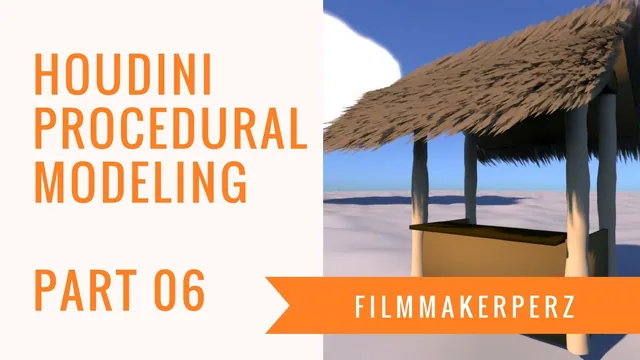
Tiki Hut Tutorial | 3D Procedural Modeling in Houdini - Part 06
Written guide
Playing loads YouTube content. YouTube processes data after activation.
Watch on YouTubeIf the player is blocked or unavailable, use Watch on YouTube.
Expose the tiki hut’s height and width on a single master-control node so small variations can be made without searching the construction network. Part 6 demonstrates custom parameters and channel references, then shows a useful limit of the asset: widening it can separate the roof, and the instructor leaves that geometric dependency unresolved.
Begin with the completed hut network and its grass covering from the preceding lessons. The exact Houdini version is unverified. This is a local parameter interface on a Null, not a packaged, broadly validated digital asset.
Create a readable control surface
At 00:00, add a Null and name it for its master-control role. Open Edit Parameter Interface. Hide the existing parameters that are not needed for this interface, then add a float parameter for the hut’s height.
At 01:06, distinguish the internal Name from the visible Label. The internal name is what references access and is entered without spaces in the demonstration. The label can use readable spacing for the person operating the control.
A float supports fractional adjustments such as 5.5 rather than only whole-number steps. The source’s automatic captions distort the exact typed names; retain a consistent meaningful internal name in the actual scene instead of reconstructing one from those captions.
Drive the existing height parameter in the correct direction
At 02:01, initialize the new height control to the existing value, about 5.5. Copy that parameter and paste a relative reference into the construction parameter that currently controls the hut’s height.
The instructor initially pastes it into the radius instead, undoes the change and applies it to the correct height channel. This is more than a cosmetic mistake: the same valid reference can drive an entirely different geometric property if placed in the wrong field.
The master control supplies the value; the construction node reads it. Moving the slider now changes the height and the pieces already linked to that height follow. Inspect the posts and roof together to confirm that the intended upstream dependency is being changed.
The lesson demonstrates this working relationship, not a full search for every unlinked dimension in the asset.
Expose the master column’s width-related position
At 03:00, add a second float for width. At 04:01, initialize it to about 2 and reference it from the master column’s X-position control used by the earlier construction.
This is a width-related placement parameter, not necessarily the hut’s complete measured width. Because earlier lessons derive other positions and dimensions from it, changing it produces a narrower or wider arrangement without editing every branch separately.
Inspect both sides after the change. A control labeled Width does not by itself guarantee that all roof lengths, overhangs and covering dimensions have been derived from that quantity.
Treat the exposed parameters as a tested range, not a finished asset contract
At 05:02, the grass recalculates from the changed geometry, but larger variations do not match perfectly and require further tweaking. The instructor also demonstrates that widening the structure can pull the roof apart.
At 06:03, a geometric repair is proposed using the Pythagorean relationship between the roof triangle’s height, span and sloped length. That calculation is discussed but not implemented. The lesson supplies neither a final expression nor a corrected roof network, and it does not establish minimum or maximum safe slider values.
Use modest variations and inspect the roof join, eaves and grass coverage at each accepted setting. If a broader range is required, the roof dependencies need additional modeling work; a nicer control interface alone cannot repair them.
The completed result is convenient access to two existing relationships. The candid failure at wider settings is part of the lesson: exposing a parameter makes a network easier to operate, but only testing its dependent geometry establishes how far that parameter can safely vary.